
Microsoft Workloads on AWS
Home / Microsoft Workloads on AWS
Secure, scalable, and cost‑optimized Microsoft solutions deployed on Amazon EC2
Service Overview
Our Microsoft Services on AWS offering enables organizations to design, migrate, and operate Microsoft workloads such as Windows Server, SQL Server, Active Directory, and Microsoft 365 integrations on Amazon Web Services. The solution is built using Amazon EC2, Amazon RDS, Amazon FSx, Amazon S3, and AWS networking services to deliver enterprise‑grade availability, security, and performance.
Reference architectures follow AWS Well‑Architected best practices including multi‑AZ deployment, automated backup, identity integration, and secure internet connectivity through load balancers and private networking.
Key Use Cases
Data Center Migration
Migrate on‑premises Windows and SQL workloads to AWS with minimal downtime and full data protection.
Disaster Recovery
Implement cost‑effective DR using AWS replication, backup, and automated failover strategies.
Hybrid Cloud Integration
Extend on‑premises Active Directory and applications securely into AWS virtual private cloud environments.
Read More Secure Application Hosting
Run enterprise Microsoft applications on scalable EC2 infrastructure with monitoring and patch automation.
Read More AWS Value Proposition
High Availability
Multi‑AZ architecture ensures resilience and uptime for mission‑critical workloads.
Security & Compliance
Identity management, encryption, and network isolation aligned with AWS security best practices.
Cost Optimization
Right‑sizing, reserved instances, and storage tiering reduce long‑term infrastructure cost.
Read More Operational Excellence
Automated monitoring, patching, and backup using AWS native management services.
Read More 
Target Customer Profile
Enterprises migrating Microsoft workloads from on‑premises data centers to AWS.
Organizations requiring secure disaster recovery or hybrid cloud architecture.
Growing businesses needing scalable Windows and SQL hosting without capital investment.
ISVs and application owners modernizing legacy Microsoft applications.
Organizations requiring secure disaster recovery or hybrid cloud architecture.
Growing businesses needing scalable Windows and SQL hosting without capital investment.
ISVs and application owners modernizing legacy Microsoft applications.

Customer Engagement & Delivery
Our engagement begins with a discovery workshop to assess current infrastructure, business goals, and compliance requirements. Based on findings, we design an AWS reference architecture and provide a detailed Statement of Work including migration timeline, cost model, and operational scope.
Delivery includes architecture deployment on Amazon EC2, secure networking configuration, workload migration, testing, optimization, and post‑deployment managed support.
Delivery includes architecture deployment on Amazon EC2, secure networking configuration, workload migration, testing, optimization, and post‑deployment managed support.

Architecture Summary
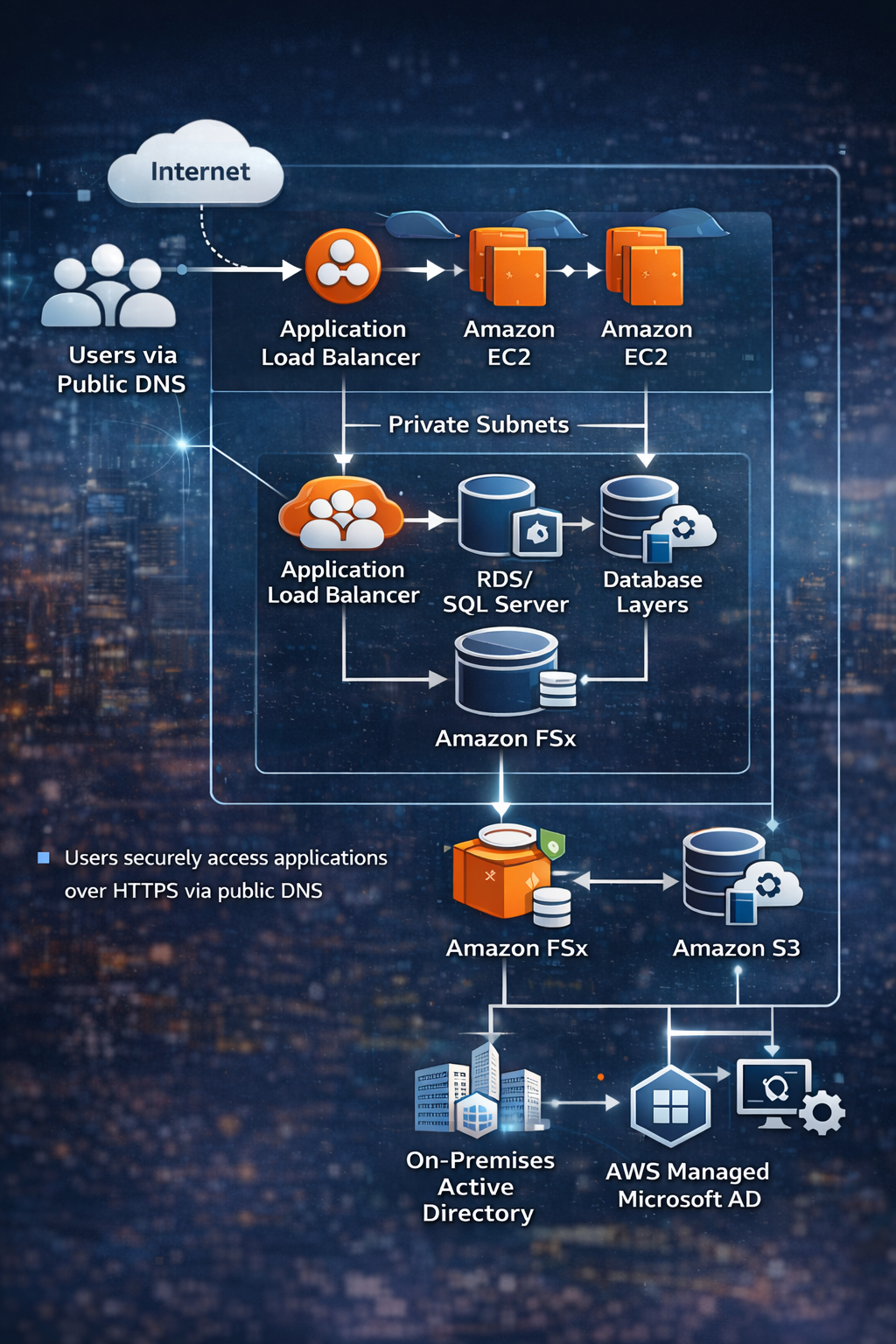
The reference architecture consists of users accessing applications through secure internet endpoints and load balancers, application workloads hosted on Amazon EC2 in private subnets, database services on Amazon RDS or SQL on EC2, shared storage using Amazon FSx, and backup protection in Amazon S3. Monitoring, patching, and automation are handled via AWS management services to ensure continuous operational health.
Read More AWS Reference Architecture Diagram
The Microsoft on AWS architecture is designed following AWS Well-Architected principles to ensure security, scalability, high availability, and operational efficiency.
-
Users securely access applications over HTTPS via public DNS and an Application Load Balancer.
-
Web and application servers run on Amazon EC2 instances inside private subnets across multiple Availability Zones.
-
Databases are hosted on Amazon RDS for SQL Server or SQL Server on EC2 with automated backup and Multi‑AZ failover.
-
Shared file storage is provided using Amazon FSx for Windows File Server.
-
Backup and archival are stored in Amazon S3 with lifecycle and encryption policies.
-
Identity integration connects on‑premises Active Directory with AWS Managed Microsoft AD or AD on EC2.
-
Monitoring and patching are automated using Amazon CloudWatch and AWS Systems Manager.